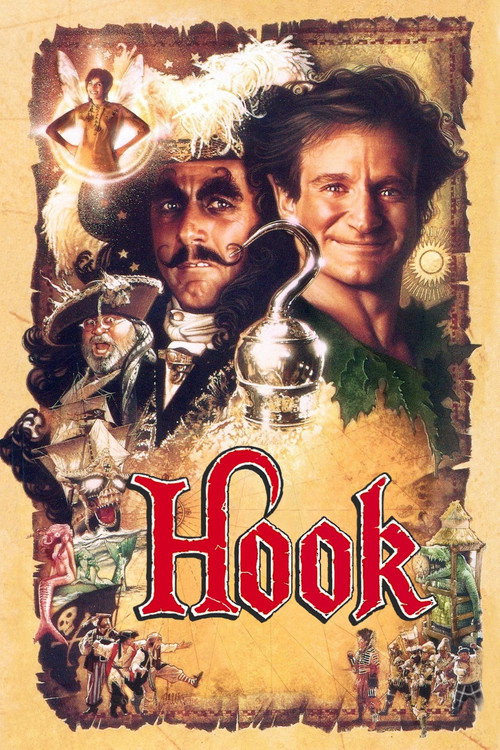
Hook
Threshold Analysis
Concerns
- The 'boo box' scene (pirate locked in chest with scorpions) is genuinely frightening for young children
- Captain Hook psychologically manipulates Peter's son Jack into rejecting his father — emotionally intense and potentially disturbing
- Extended insult battle among the Lost Boys models crude, mean-spirited speech played as humor
- Magic and flying are powered by inner emotion/happy thoughts — a humanistic source of supernatural power
- Moderate sword violence and peril throughout, intense for a PG rating
- Tinker Bell's romantic feelings for Peter introduce a mild love-triangle element
- Captain Hook's death (eaten by a crocodile) may be disturbing for sensitive viewers
Positives
- Powerful message about fatherhood: being present for your children is more important than career success
- Father-son reconciliation is the emotional heart of the film — forgiveness and restored relationship
- Workaholism is portrayed as genuinely destructive, not glamorized
- Sacrificial love is demonstrated by multiple characters
- Granny Wendy models wise, faithful, nurturing grandmotherhood
- The villain is clearly portrayed as evil and manipulative — moral clarity between good and evil
- Imagination, play, and childhood wonder are valued — consistent with raising joyful children
- Marriage is honored — Peter ultimately chooses his wife and family over Neverland and adventure
Content Flags
Several uses of 'hell,' 'damn,' and 'ass.' Some name-calling throughout ('stupid,' 'slugs,' 'old, fat, wrinkled'). The Lost Boys engage in an extended insult battle with creative but crass put-downs. A few borderline crude phrases. No f-words or s-words. Approximately 5-8 mild profanities total.
Sword fighting throughout, including an extended climactic duel between Peter Pan and Captain Hook. Hook threatens children with a hook to the throat. A pirate is placed in a 'boo box' (a chest full of scorpions) as punishment — played for dark humor but quite frightening for young children. Characters are struck, kicked, and thrown. Captain Hook is ultimately eaten/swallowed by a crocodile (the stuffed crocodile comes to life). Food fight scene with imaginary food. Some slapstick violence. A pirate is shot from a cannon. Hook emotionally manipulates Peter's son Jack, turning him against his father — psychologically intense. Overall the violence is adventure-style but more intense than typical family fare.
Tinker Bell (Julia Roberts) grows to human size and confesses romantic love for Peter, leaning in to kiss him — played as bittersweet. Some mild flirtation. The mermaids are portrayed in a mildly sensual manner. Peter and his wife Moira share a kiss. Nothing explicit, but the Tinker Bell scene introduces a romantic dynamic that goes beyond the traditional fairy tale.
The story is rooted in the Peter Pan mythology which includes fairy dust enabling flight, a fairy (Tinker Bell) with magical powers, Neverland as a magical realm where children don't age, and imaginative/magical elements throughout. Peter must 'find his happy thought' to fly — this is presented as a power from within oneself activated by positive emotion. Tinker Bell uses pixie dust and magic. A crocodile sculpture magically comes to life. These are fairy-tale fantasy elements rather than dark occult, but the magic is presented as empowering and aspirational.
Captain Hook drinks from a goblet (implied wine/alcohol) in a few scenes. Some background pirate revelry that would include drinking. Nothing heavy or focused on substance use.
Mermaids appear in one scene wearing seashell-style coverings — some cleavage visible. Tinker Bell's outfit is form-fitting throughout. One brief scene where the large Lost Boy Thud Butt exposes his backside. Nothing explicit.
A few casual uses of 'Oh my God' and 'Oh God' as exclamations. No direct mockery of Christianity or faith. Captain Hook swears 'by all that is unholy' or similar pirate-style oaths.
This is the film's greatest strength. Strong themes of fatherhood, family priority, and redemption. Peter Pan/Peter Banning learns that his children are more important than his career. He must literally fight to get his children back — a powerful metaphor for fathers re-engaging with their families. The film clearly portrays workaholism as destructive and present fatherhood as essential. Peter's son Jack's anger toward his absent father is realistic and resolved through reconciliation. Sacrificial love is demonstrated. Granny Wendy (Maggie Smith) is a warm, wise, nurturing maternal figure. The Lost Boys represent community and loyalty. Tinker Bell sacrificially helps Peter even knowing he loves his wife. The climax centers on a father's love being stronger than a villain's manipulation.
Overview
The boy who wasn't supposed to grow up—Peter Pan—does just that, becoming a soulless corporate lawyer whose workaholism could cost him his wife and kids. During his trip to see Granny Wendy in London, the vengeful Capt. Hook kidnaps Peter's kids and forces Peter to return to Neverland.